
Where Can You Put an ADU on a Quarter-Acre Lot in Charlotte?
Thinking about an accessory dwelling unit in Myers Park, Eastover, Cotswold or surrounding neighborhoods?
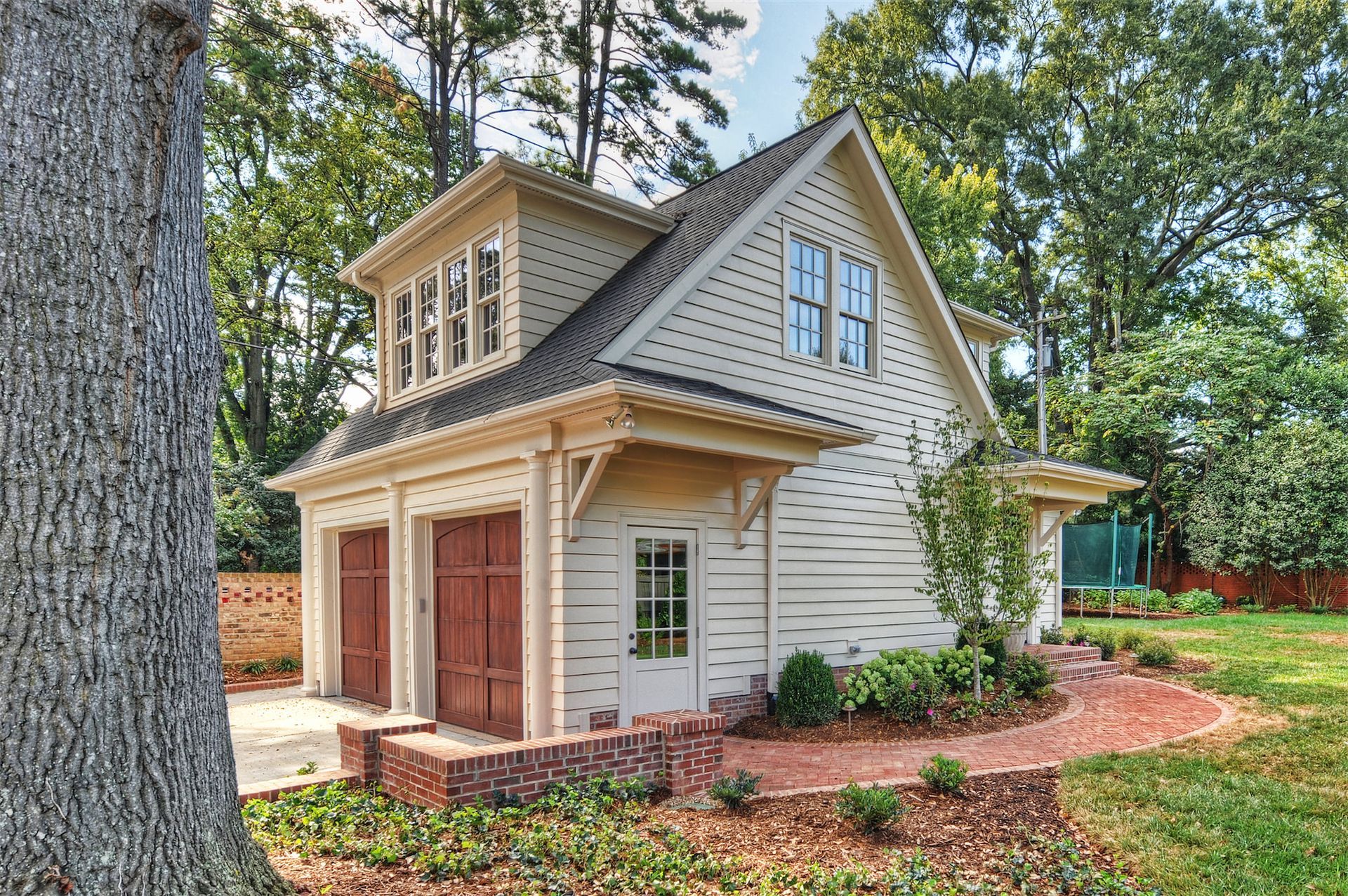
On a typical quarter-acre lot in Charlotte, you can usually build an ADU up to about 1,000 heated square feet, shorter than 24 feet, placed behind the principal structure with 3-foot side setbacks and specific rear setbacks. The details, exceptions, and specific rules from Charlotte's UDO are below.
The most important factor controlling where an Accessory Dwelling Unit (ADU) can go on your lot is the height of the structure. If the ADU is less than 24 feet in height it can be placed as close as 3 feet from the side and rear property lines. However, if the ADU is 24 feet high or taller, it must be placed further away from the property lines, a minimum of 15 feet from the rear property line and roughly 5 or 6 feet from the side property line (the side yard setback varies depending on the particular neighborhood). Yes, it is somewhat complicated, much easier when taken step by step.
There is a difference between an "Accessory Structure" and an "Accessory Dwelling Unit".
You will hear both definitions and it can get confusing. The two are different categories, and an ADU is both.
Accessory structure is a building/structure classification: a structure on the same lot as the principal building that is incidental and subordinate to its function. Sheds, detached garages, pool houses, carports, fences, decks. Governed by Article 17 of Charlotte's Unified Development Ordinance (UDO). City of Charlotte
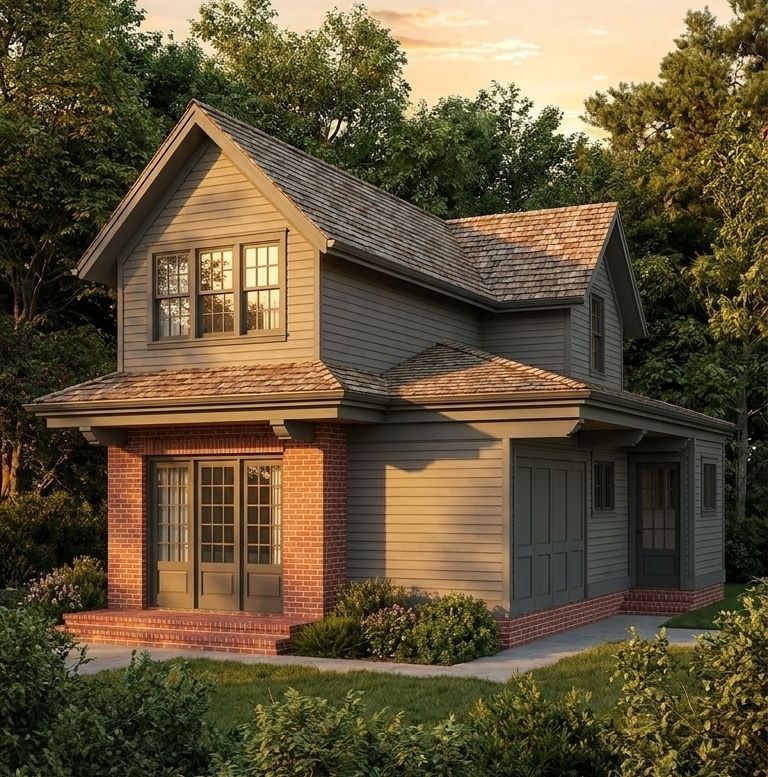
Accessory dwelling unit (ADU) is a use, a listed use in Article 15 (UDO). An additional dwelling unit associated with and incidental to a principal dwelling, which must include separate cooking and sanitary facilities and be a complete, separate dwelling unit. It may be within or attached to the principal dwelling, or within a detached accessory structure such as a garage. Governed by the prescribed conditions in Section 15.6. City of Charlotte. Think of an ADU as being a small house, both in function and cost.
Does the distinction control where it can go?
Mostly no. Placement of a detached ADU is controlled by its status as an accessory structure, not by its ADU status. The ADU label does matter in determining the maximum size, however.
The categories overlap rather than compete. A detached ADU is an accessory structure, and it must satisfy both Article 17 (form/placement) and 15.6 (use conditions). Accessory structures that are not ADUs comply with Article 17.1; those that are ADUs must also comply with Article 15.6. Practically, the dividing line is whether the building has cooking and sanitary facilities and is used as a residence, when you declare an accessory structure "is not" an ADU on the permit application, you are confirming it won't be used as a dwelling for short or long-term durations.
Charlotte operates under its Unified Development Ordinance, or UDO, which took effect in 2023 and replaced the old zoning code that had governed the city for decades. The UDO reorganized how residential districts are labeled and how ADUs are treated, and the result is actually a fairly permissive framework for homeowners who want to add a second living unit on their property. That said, permissive doesn't mean unlimited. There are setbacks, height limits, size caps, and coverage rules that will directly determine where your ADU can go and whether it can go there at all.
This post is going to walk you through what those rules actually mean on a typical quarter-acre Charlotte lot. We'll cover placement, setbacks, height, floor area, and building coverage, because all of those pieces work together. Understanding them as a system, rather than as isolated rules, is what separates a project that sails through permitting from one that stalls out six months in because the design wasn't grounded in the realities of the lot.
So, let's do the homework. Because as we always say: do your homework… do your homework. And also always check for amendments to the UDO, which can add or subtract requirements.
First: What Exactly Is a Quarter-Acre Lot?
A quarter acre is 10,890 square feet. In Charlotte's older established neighborhoods, think Dilworth, Plaza Midwood, Commonwealth, Cotswold, Eastover, and many parts of South Charlotte, lots in this range are extremely common, and you might own one. They're the workhorses of the Charlotte housing stock, sized to hold a modest to substantial single-family home with a real yard on all four sides.
In the UDO's Neighborhood 1 districts, which cover most of Charlotte's single-family residential fabric, a quarter-acre lot at 10,890 square feet lands just above the minimum lot size threshold for an N1-A district, which requires a minimum of 10,000 square feet. That's important because it means your lot qualifies for all of the residential development rights that come with N1-A zoning, including the ability to add an ADU.
But before we talk about the ADU specifically, we need to understand the lot's buildable envelope. That's the area left over after all the required setbacks are applied to the principal structure. The ADU will then fit into whatever is left, and those two things don't compete with each other in the way many people assume. Let's walk through how that works.
Understanding the Setbacks on Your Principal Structure
In the N1-A zoning district, the primary structure on your lot is subject to the following minimum setbacks under the UDO:
- Front setback: Typically 20 feet from the right-of-way, though this can vary based on the established blockface (the UDO allows some flexibility if neighboring homes are already set back differently). In no case can it be less than 10 feet.
- Side setbacks: 5 feet minimum from each interior side lot line.
- Rear setback: 40 feet minimum from the rear lot line.
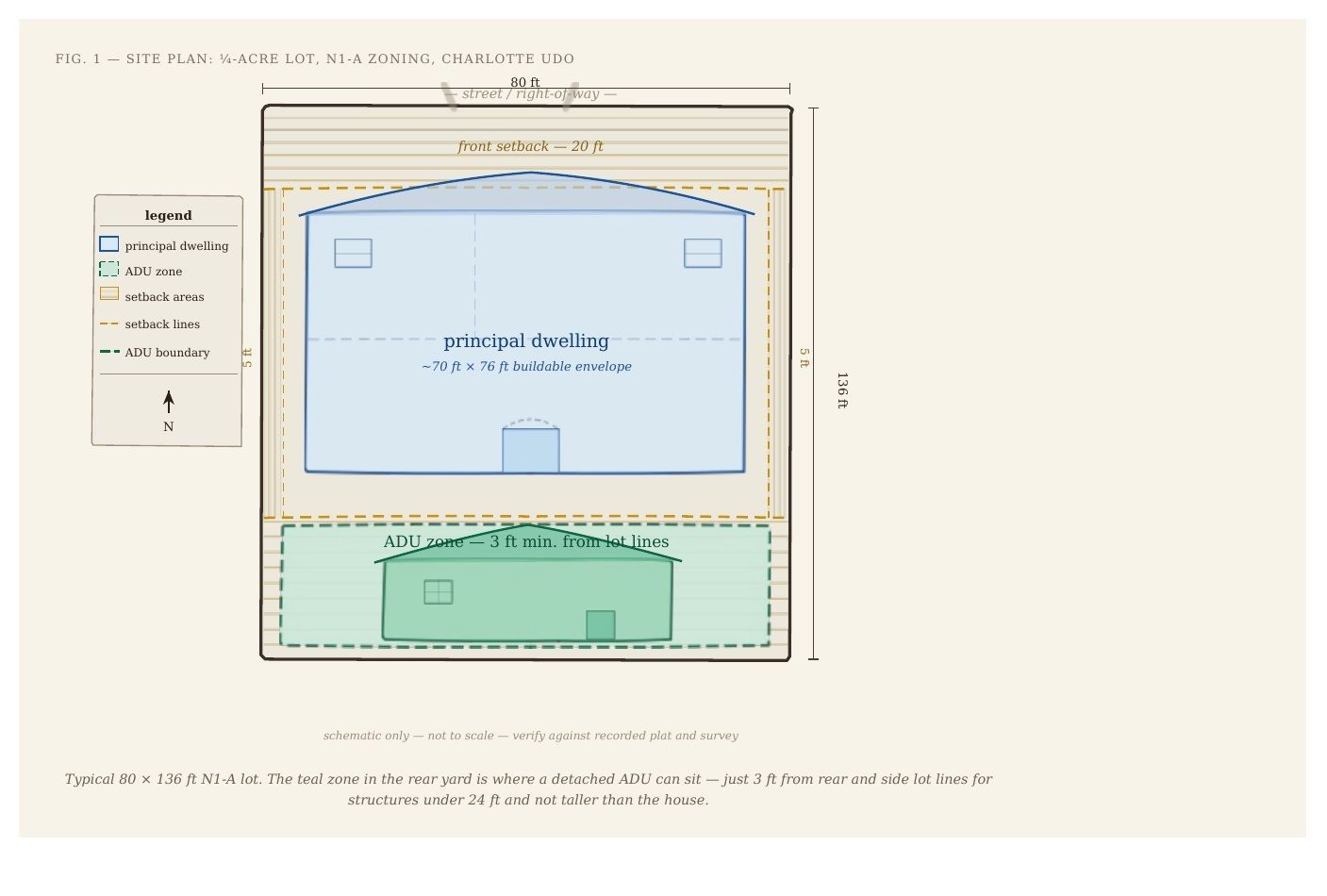
On a quarter-acre lot, these setbacks carve away a meaningful portion of the usable area. Let's say the lot is roughly 80 feet wide and 136 feet deep, a common configuration in Charlotte's grid neighborhoods. Once you apply a 20-foot front setback and a 40-foot rear setback, you've already consumed 60 feet of that 136-foot depth. Add the two 5-foot side setbacks and you're left with a 70-foot-wide by 76-foot-deep buildable envelope for the primary home: about 5,320 square feet of gross footprint potential before building coverage rules apply.
That's for the principal structure. The ADU has its own separate placement rules, and they're meaningfully different, and in some ways more forgiving.
Where Can the ADU Actually Go?
Here is the fundamental principle that guides ADU placement in Charlotte: an ADU located within a detached accessory structure is generally subject to accessory structure setbacks, not the principal structure setbacks. For the purposes of this discussion we will focus on detached structures, versus attached to the house itself (and not considering through-lot conditions).
Under Article 17 of the Charlotte UDO, accessory structures in an established side or rear yard must be located a minimum of three feet from any lot line, side or rear. That's it. Three feet (but another foot or two will avoid the requirement for a fire rated wall or eave detail). Compared to the 40-foot rear setback required for the principal dwelling, this is a dramatic difference, and it opens up significant territory in the back of most quarter-acre lots.
Let's put that in context. On our hypothetical 80x136 lot, the rear 40 feet is entirely off-limits for the primary house. But it's largely available for an ADU, as long as the ADU maintains that 3-foot buffer from the rear and side property lines. In practice, that leaves you with roughly a 74-foot-wide by 37-foot-deep footprint zone in the rear yard. Do the math and you have approximately 2,738 square feet of potential ADU footprint territory. That's well more than enough for any ADU that complies with Charlotte's size limits.
There's an equally important point about where the ADU cannot go: it may not be located in the front setback or corner side setback along a street. In plain language, this means no ADU in the front yard, facing the street as a second primary structure. The only narrow exception in the UDO involves lots where the principal dwelling is set back at least 150 feet from the right-of-way, a situation that simply doesn't apply to most in-town Charlotte lots. There must also be a separation between the house and an ADU of at least 5 feet.
The ADU must also share a driveway with the principal structure, with some exceptions for corner lots and lots abutting alleys. You cannot carve out a separate curb cut and driveway for a detached ADU on a standard interior lot. This matters for site planning, and it's something to think about early in the design process.
The Height Question: This Is Where Things Get Specific
Height is one of the most important and most misunderstood pieces of the ADU puzzle in Charlotte. Get it right, and your design has maximum flexibility. Get it wrong, and you'll find yourself re-drawing plans you've already fallen in love with.
Here's the old rule: an ADU located within a detached accessory structure may not exceed the height of the principal dwelling. That condition was removed from the UDO by text amendment 2025-047. There is certainly lingering, false adherence to this rule, but now an accessory structure can be taller than the primary residence.
The remaining height-related rule, and this one affects setbacks, not just design: if an accessory structure reaches a height of 24 feet or more the setback requirements change significantly. In that case, the structure must be set back at least 15 feet from the rear lot line and at least the full required side setback (5 feet in N1-A) from any side lot line. That's a very different building location than the 3-foot minimum that applies to lower structures.
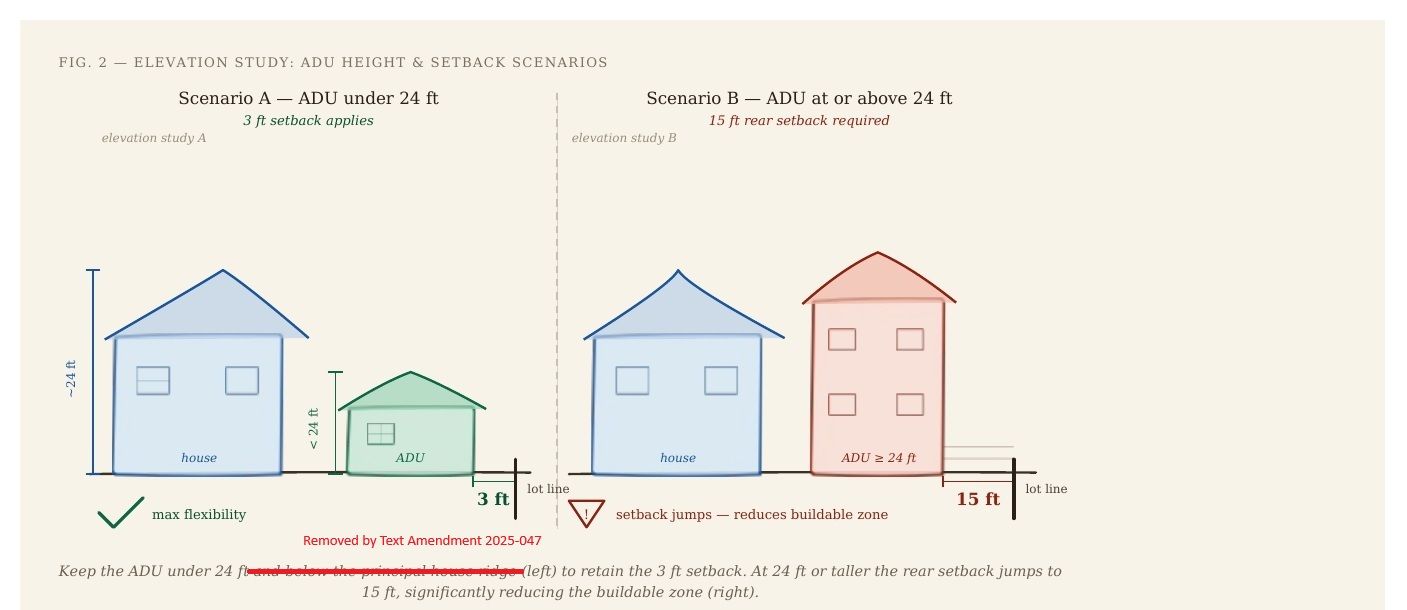
What this means in practice is that a taller ADU will be subject to tighter setbacks and may not work on a smaller or shallower lot. A shorter, single-story ADU designed to stay well under the 24-foot height threshold will have the most placement flexibility and the largest buildable footprint zone. This is often the most cost-effective path as well.
The takeaway here: design the ADU height with intentionality. Don't assume you can maximize height simply because the lot is large or the district allows taller buildings.
How Big Can the ADU Be? Understanding Floor Area Limits
Even when placement and height work out, there are firm size limits for ADUs in Charlotte. Under Article 15.6 of the UDO, a detached ADU, one located within a freestanding accessory structure, shall not exceed 600 heated square feet or 70% of the total floor area of the principal residential use, whichever is greater. However, in no case shall the ADU exceed 1,000 heated square feet.
Let's run through a few scenarios to make that concrete:
If your home is 1,200 square feet, 70% is 840 square feet. Your ADU cap is 840 square feet.
If your home is
2,000 square feet, 70% is 1,400 square feet. But your hard ADU max. cap is 1,000 square feet.
The 1,000-square-foot ceiling is the hard limit no matter the size of the primary home. This is actually a well-designed provision that reflects the underlying intent of the ADU framework: the unit should be genuinely subordinate to the primary residence. An ADU that rivals or exceeds the main house in size isn't really accessory to anything.
For most homeowners on a quarter-acre lot in Charlotte, the practical ADU size falls somewhere between 600 and 1,000 heated square feet. In that range, you can build a fully functional one- or two-bedroom unit with a kitchen, full bath, living area, and real storage. We've designed garage apartments, backyard cottages, and carriage house units in this size range, and the results are consistently livable, charming, and, done right, indistinguishable in quality from a small primary home. The 1,000-square-foot limit is not a constraint to lament. It's a framework to design well within.
It's also worth noting that this floor area limit applies specifically to an ADU within an accessory structure. Attached ADUs, those carved out of existing basement space, added above an attached garage, or built as an addition to the main house, operate under somewhat different provisions. If you're considering an attached ADU, that's a separate conversation worth having with your architect.
Building Coverage: The Often-Overlooked Variable
Here's the calculation that catches the most people off guard: overall building coverage.
In the N1-A district, Charlotte's UDO limits maximum building coverage to 40% of the lot area for lots of 10,000 square feet or greater. On a 10,890-square-foot lot, that means all structures combined, principal dwelling, detached ADU, garage, sheds, covered porches, and any other roofed structures, cannot collectively occupy more than 4,356 square feet of ground area.
For many Charlotte homeowners, this number is tighter than it first appears. If the primary home has a first-floor footprint of 2,500 square feet, which is common for a 3,000- to 3,500-square-foot two-story house, you've already consumed roughly 57% of your coverage allowance before you've placed a single square foot of ADU. The ADU would need to be fully accounted for within whatever coverage headroom remains, which in this case is 1,856 square feet. The allowable area for the ADU then hits the 1,000 square foot maximum, subject also to the Rear Yard Coverage discussed below.
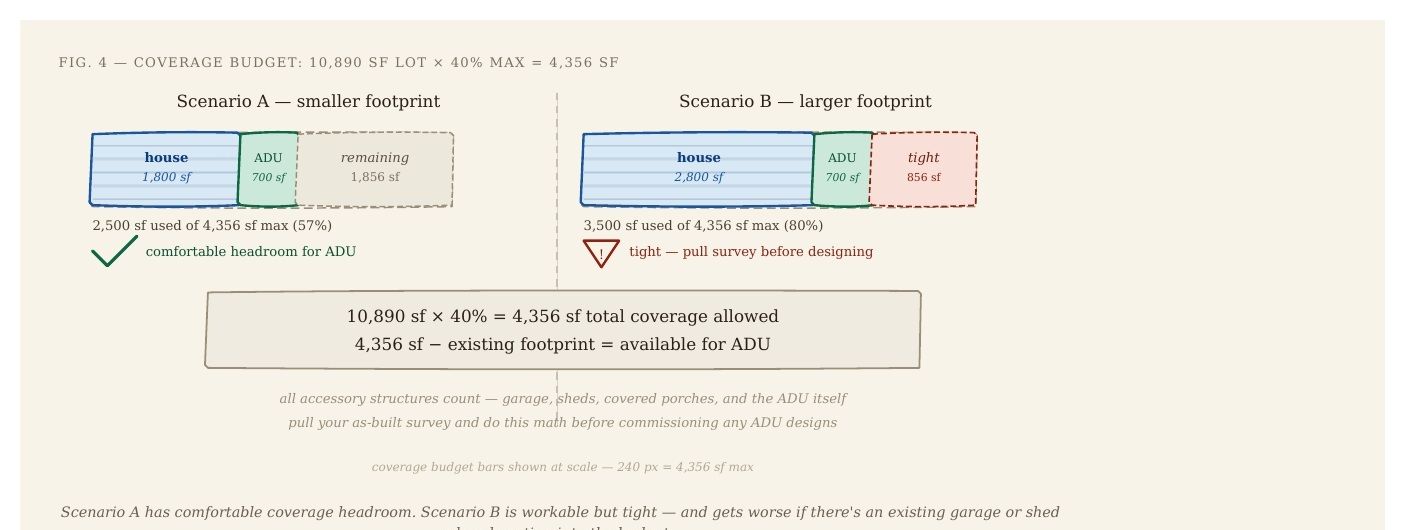
This is why we counsel clients to pull their as-built surveys and do this coverage math early, ideally before they've commissioned any ADU designs. The survey will tell you the existing building footprint. The lot dimensions will tell you the maximum coverage. The difference between those two numbers is your remaining buildable coverage, and that number sets the upper boundary on ADU footprint size more definitively than almost anything else.
It's also worth noting that the UDO has a separate provision governing the aggregate square footage of all accessory structures on a lot (excluding the ADU). That total cannot exceed the total heated area on the first floor of the principal structure. If you have an existing detached garage or workshop, that structure counts against this limit. Your design team needs to account for everything on the lot, not just the ADU in isolation.
The One-ADU Rule and Other Key Conditions
A few more items worth understanding clearly before you get too far down the planning road:
Only one ADU per lot. The UDO allows exactly one accessory dwelling unit per lot containing a single-family or qualifying duplex. You cannot layer an attached ADU and a detached ADU on the same property. Pick one configuration and design it well.
The ADU must include separate cooking and sanitary facilities. A structure without a kitchen and a private bathroom isn't an ADU under the code, it's a guesthouse or an accessory structure, which has different rules and restrictions. If income generation or independent living is the goal, the ADU must be fully self-contained.
Ownership requirements. The principal dwelling and the ADU must remain under the same ownership. You cannot subdivide the lot, sell off the ADU as a separate parcel, or separately deed the two structures. The ADU is, by definition, an accessory to the primary use of the lot.
Permits are required. This should go without saying, but it's worth emphasizing: building an ADU without permits creates serious problems, for liability, for insurance, for refinancing, and for eventual resale. The permitting process in Charlotte, through Mecklenburg County's CLT Development Center, has improved significantly and is manageable with the right team in place.
Charlotte's New Queen City ADU Program
One more piece of news that's genuinely exciting: in September 2025, the City of Charlotte launched the Queen City ADU Program, which offers qualifying homeowners up to $80,000 in forgivable, interest-free financing to help fund ADU construction. The loan forgives at a rate of $10,000 per year over up to eight years, with faster forgiveness available for landlords who house voucher holders or residents referred through supportive service agencies.
The program targets rental affordability, units must be rented to tenants earning no more than 80% of area median income, at rents capped at the city's published Fair Market Rent levels. It's not the right fit for every homeowner, but for those whose goals align with the affordability targets, this is a remarkable tool that changes the financial calculus of ADU construction significantly.
The City also offers a free online MyADU Eligibility Tool that lets you check whether your specific property appears eligible before you invest in design or planning work. That's a smart first step for anyone seriously considering the program.
Putting It All Together: What to Do Next
If you've read this far, you probably have a specific lot in mind, and a specific idea about what you'd like to build. Here's how we'd advise you to approach it:
Step 1: Pull your survey. Find your most recent as-built survey, which shows the lot dimensions, existing structures, easements, and setbacks. If you don't have one, order one. This is not an optional step.
Step 2: Confirm your zoning district. Charlotte's online mapping tools will tell you whether you're N1-A, N1-B, N1-C, or something else. Each district has its own setbacks and coverage limits. Know yours before you do anything else.
Step 3: Calculate your coverage headroom. Add up the footprint square footage of all existing structures. Compare that to your lot's 40% coverage ceiling. The difference is your available envelope.
Step 4: Hire an architect. Have a professional apply the placement rules to your specific survey, sketch one or two feasibility concepts, and tell you honestly whether your goals are achievable. This is far cheaper than commissioning full construction documents only to discover a fatal constraint three months into the design process. See our blog post on architecture fees.
Step 5: Hire a builder for a preliminary budget. Before you finalize the design, get a real cost number from a qualified contractor. The Charlotte construction market has remained competitive, and ADU costs vary enormously depending on finishes, site conditions, and utility connections.
Armed with accurate survey data, confirmed zoning information, a feasibility design, and a preliminary cost estimate, you'll be in a position to make a genuinely informed decision. That combination of professional inputs, done in the right sequence, is the homework. And doing the homework is the only reliable way to avoid the costly mistakes we see time and again when homeowners charge ahead without it.
Frequently Asked Questions
How much does an ADU cost?
Remember that an ADU is basically a small house, so in general they are not cheap structures. Short answer for Charlotte right now: budget $200–$280 per square foot blended across both floors if the lower level is a garage with living space above, putting the cost in the $300,000–$400,000 range. If the ADU is all finished space the budget needs to be in the $400 per square foot range.
How long does it take to design and build the ADU?
If you are motivated you could design the ADU in four months. Three months for pricing, permitting, and mobilization for construction. Construction duration of 10 months. Total time is 17 months - roughly 1 1/2 years from start to finish.
What do people miss?
ADUs tend to be very close to the property line and can impact the neighbors privacy quite a bit. I think it is important to position windows where you are respectful of your neighbors.
Final Thought
Charlotte's ADU rules are, on balance, working in your favor. The UDO framework is more permissive than many homeowners expect, the City has backed its commitment to ADUs with real financial tools, and a quarter-acre lot in most established Charlotte neighborhoods has the raw material to accommodate a well-designed additional unit.
The variable that will determine whether your project succeeds isn't the code. It's the quality of the team you assemble and the discipline you bring to the planning process. Get that right, and an ADU on a quarter-acre Charlotte lot is very much within reach.
When you're ready to have that conversation, we're here.
Shoot us an email or give us a call.
Houghland Architecture is a Charlotte, NC–based architectural firm with three generations of experience in residential design. We work with homeowners, builders, and developers across North Carolina, South Carolina, and Virginia. Call us at 704-650-1148 or email gray@houghlandarchitecture.com.
The zoning information in this post reflects the Charlotte Unified Development Ordinance (UDO) and City programs as understood in mid-2026. Regulations are subject to change. Always verify current standards with the City of Charlotte Planning and Development Department or a licensed design professional before making project decisions.New Paragraph